
How Do You Qualify a Backup Supplier for Research Chemicals?
How Do You Qualify a Backup Supplier for Research Chemicals?
A delayed shipment or inconsistent reagent lot can disrupt experiments, compromise reproducibility, and stall critical R&D timelines. If you are asking, “How do I qualify a backup supplier for research chemicals?” the answer goes beyond comparing prices and delivery promises. Effective qualification requires a risk-based review of chemical identity, purity specifications, certificates of analysis, traceability, storage conditions, and supply reliability—followed by testing in your intended application.
The practical goal is not to find an identical catalog listing. It is to establish that an alternative source can deliver material suitable for a defined use, with enough evidence to support switching when necessary. A supplier may be acceptable for exploratory synthesis but unsuitable for a sensitive cell-based assay. Qualification therefore belongs to a specific chemical, specification, and application—not just a company name.
Start with the experiment, not the supplier questionnaire
Before requesting documents, identify what a substitution could change. A routine cleaning solvent and a compound used to generate reference data do not warrant the same qualification effort. Consider the consequences of failure, the likelihood that impurities affect results, and whether a problem would be detected before valuable samples are consumed.
For lower-risk materials, a documented specification review and incoming inspection may be sufficient. Chemicals that influence assay sensitivity, cell viability, analytical calibration, or a critical synthesis step usually need additional verification. Materials supporting regulated activities may also require formal quality oversight and change control, depending on their use and applicable requirements.
Build a short qualification brief around the actual material:
- Exact identity, including salt form, stereochemistry, hydration state, concentration, and formulation where relevant.
- Required grade, assay range, impurity limits, and application-specific attributes.
- Packaging, storage, transport, and minimum remaining shelf-life requirements.
- The experiment or process that will demonstrate suitability.
- Who can approve the material and what would prevent its release.
Use the primary supplier’s performance as a reference, but do not copy its catalog specification uncritically. Your laboratory may rely on an attribute that the catalog does not control. That gap needs to become an explicit acceptance criterion.
Read beyond the chemical name and purity percentage
Matching a CAS number is a useful screening step, not proof of interchangeability. Confirm the molecular form and composition against technical documentation. Hydrates, solvates, counterions, and stereoisomers can affect calculations and experimental behavior even when product descriptions look similar.
Purity figures require particular care. An HPLC area percentage does not necessarily establish mass fraction, water content, or absence of inorganic contaminants. Two suppliers may report similar numbers using different methods, detection conditions, or calculation bases. Ask what the result measures and which impurities the method can detect.
Depending on the application, decision-driving attributes might include residual solvents, water, trace metals, optical purity, pH, or solubility under actual working conditions. For chemicals introduced into biological systems, endotoxin or bioburden may matter, but these should be specified because the application requires them—not added as universal purchasing requirements.
Grade labels also need interpretation. “Research grade” does not establish suitability for diagnostic or therapeutic use. A material acceptable during discovery may need a separate qualification pathway if the project moves into a regulated workflow.
Make the document review lot-specific
Request a representative certificate of analysis early, then obtain the certificate for the actual evaluation lot before testing. A generic specification sheet shows what the supplier promises; a lot-specific CoA shows what it reports for the material being delivered.
Check the lot number, specifications, results, methods or method references, and relevant dates. Distinguish numerical test results from statements such as “conforms.” Neither format automatically establishes adequacy, but critical attributes need enough detail to judge acceptance. Missing information should lead to a technical question, not an assumption.
A safety data sheet serves a different purpose. It supports hazard communication, handling, and transport decisions; it does not replace evidence of chemical identity or purity. Likewise, a quality-system certificate can inform supplier assessment, but its scope must cover the relevant activities. It does not prove that a particular lot meets your requirements.
Traceability becomes especially important when the seller is a distributor. Establish whether material is supplied in the manufacturer’s original packaging, repackaged, or relabeled. Ask how manufacturer and distributor lot numbers are linked and whether complaints can be traced back to the source batch.
Check whether the backup is genuinely independent
Two vendors can depend on the same manufacturer, production site, or upstream feedstock. If both draw from the same constrained source, adding a second vendor may improve ordering flexibility without reducing the underlying supply risk.
Ask what the supplier manufactures, what it distributes, and which locations support the product. Full disclosure may not always be available, but unanswered questions should remain visible in the risk assessment. “Stock available” also needs clarification: local inventory, stock overseas, and material awaiting production are different delivery commitments.
Evaluate the normal replenishment route as well as the emergency order. Relevant questions include batch availability, minimum order quantity, remaining shelf life, hazardous-goods restrictions, and import documentation. For temperature-sensitive chemicals, agree on packaging and how transit excursions will be assessed. A temperature logger provides evidence; it does not, by itself, establish stability.
A trial shipment through the intended route can reveal documentation gaps, damaged seals, unsuitable packaging, or customs delays before a critical order depends on that route. Confirm lawful procurement and import requirements with the appropriate local specialists, particularly for restricted or controlled chemicals.
Test suitability before the shortage arrives
Document review determines whether a candidate deserves evaluation. It cannot establish that the material will behave acceptably in your method. Qualification testing should connect incoming checks to application performance, with acceptance criteria agreed before results are generated.
A useful sequence is to verify receipt condition and documentation, perform risk-relevant analytical checks, and then compare the candidate with an accepted primary-source lot in the intended workflow.
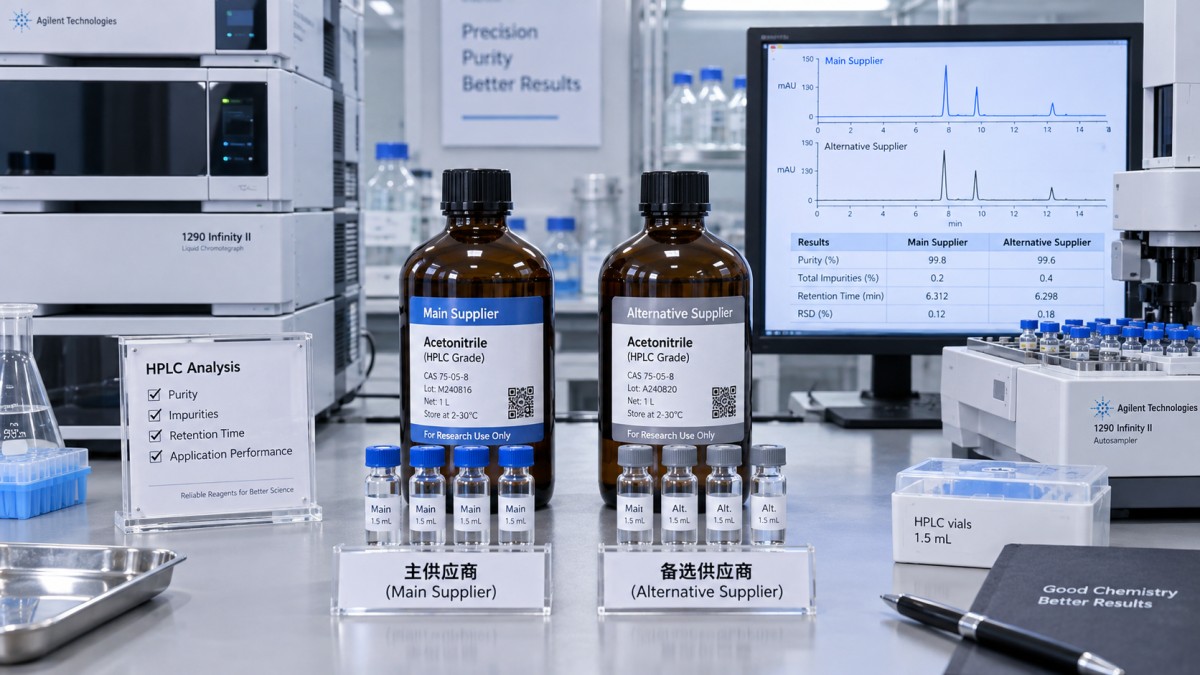
Choose analytical methods according to the uncertainty you need to resolve. Identity confirmation might involve spectroscopy or chromatography; water or trace-metal concerns require suitable targeted methods. Repeating every supplier test is not always justified, but relying entirely on the CoA may leave important risks unexamined.
For application testing, keep other variables stable. Use the same preparation procedure, instrument settings, sample handling, and controls where practical. Compare outcomes that matter to the work: background signal, recovery, assay variability, cell response, reaction yield, or impurity formation. Testing a material at a convenient concentration is not enough if the actual application uses a different range.
Define acceptable differences using method performance and scientific relevance. “No statistically significant difference” is not automatically evidence of equivalence, especially with limited replication. The study needs enough information to detect a difference that would change the decision.
One passing lot demonstrates suitability of that lot under the tested conditions; it offers limited evidence of lot-to-lot consistency. For higher-risk chemicals, evaluate additional lots when feasible, or require enhanced release checks on subsequent deliveries. Record that limitation rather than describing a small study as broad validation.
Turn the evidence into a bounded approval
Avoid an approval that simply says “supplier qualified.” Record the supplier entity, product code, chemical form, specification version, permitted applications, and any restrictions. If approval depends on a particular manufacturing site or packaging configuration, make that dependency explicit.
The qualification file should connect the risk assessment, supplier responses, document review, test protocol, results, deviations, and final decision. Research staff should approve scientific suitability; procurement should confirm commercial and delivery arrangements. Quality or compliance personnel should participate where the workflow requires them.
Conditional approval can be appropriate when its boundaries are clear. For example, material might be released only after an incoming identity check and an application control pass. A non-negotiable failure—incorrect identity, unresolved traceability, or unacceptable assay interference—should not be offset by a favorable price or short lead time.
Keep the alternative ready to use
A backup supplier can become unusable while remaining on the approved list. Product specifications change, distribution agreements end, and dormant accounts develop ordering problems. Review readiness according to material risk and supply conditions rather than assuming initial qualification lasts indefinitely.
Agree which changes require notification: manufacturing location, synthesis route, raw-material source, test method, specification, or packaging may all be relevant. Track delivery performance and technical responsiveness alongside quality complaints. A supplier that cannot explain a questionable result creates a different risk from one that investigates promptly and provides supporting records.
Keep a switching plan close to the purchasing record. It should identify the approved product, required receipt tests, release authority, storage needs, and experiments that need bridging checks. Where feasible, periodic purchases through the backup route can keep ordering and receipt processes tested.
This intersection of reagent science, laboratory operations, and supply-chain judgment reflects Global Bioscience & Lab Solutions’ focus on connecting life-science discovery with practical technical intelligence. Public supplier information helps identify candidates; qualification still rests on evidence tied to your laboratory’s use.
Start with the chemical whose absence would stop the most consequential work. Define what must remain unchanged, obtain a traceable evaluation lot, and agree on the test that will justify substitution. The useful backup is the one you can release with documented confidence—not merely the one that answers an urgent quotation request.
Get weekly intelligence in your inbox.
No noise. No sponsored content. Pure intelligence.