
Where Life Sciences Labs Lose Time Without Noticing
In life sciences labs, lost time rarely comes from one obvious failure—it leaks through routine steps across laboratory equipment, In-Vitro Diagnostics (IVD), immunoassays, POCT workflows, cell cultures, antibodies handling, and microscopic imaging. As precision demands rise with laser technology and faster decision cycles, recognizing these hidden inefficiencies is essential for researchers, operators, evaluators, and decision-makers aiming to improve accuracy, compliance, and productivity.
For lab operators, those losses show up as repeated sample preparation, instrument waiting time, rechecks, interrupted documentation, and small process deviations that appear harmless in isolation. For procurement teams and technical evaluators, the same issue appears differently: fragmented systems, unclear maintenance burden, weak interoperability, or equipment that meets a specification sheet but slows actual throughput.
In modern life sciences environments, a delay of 5 minutes repeated 20 times a day can quietly remove more than 1.5 staff hours from productive work. When this pattern spans molecular diagnostics, cell culture routines, cold chain handling, and imaging analysis, the result is not just slower research. It can affect compliance readiness, batch consistency, turnaround targets, and purchasing ROI.
This article examines where time disappears in life sciences labs without obvious warning, why those losses matter across technical and commercial roles, and how laboratories can reduce them through better workflow design, equipment selection, data discipline, and implementation planning.
Hidden Time Loss Starts in Routine Workflow, Not Only in Major Failures
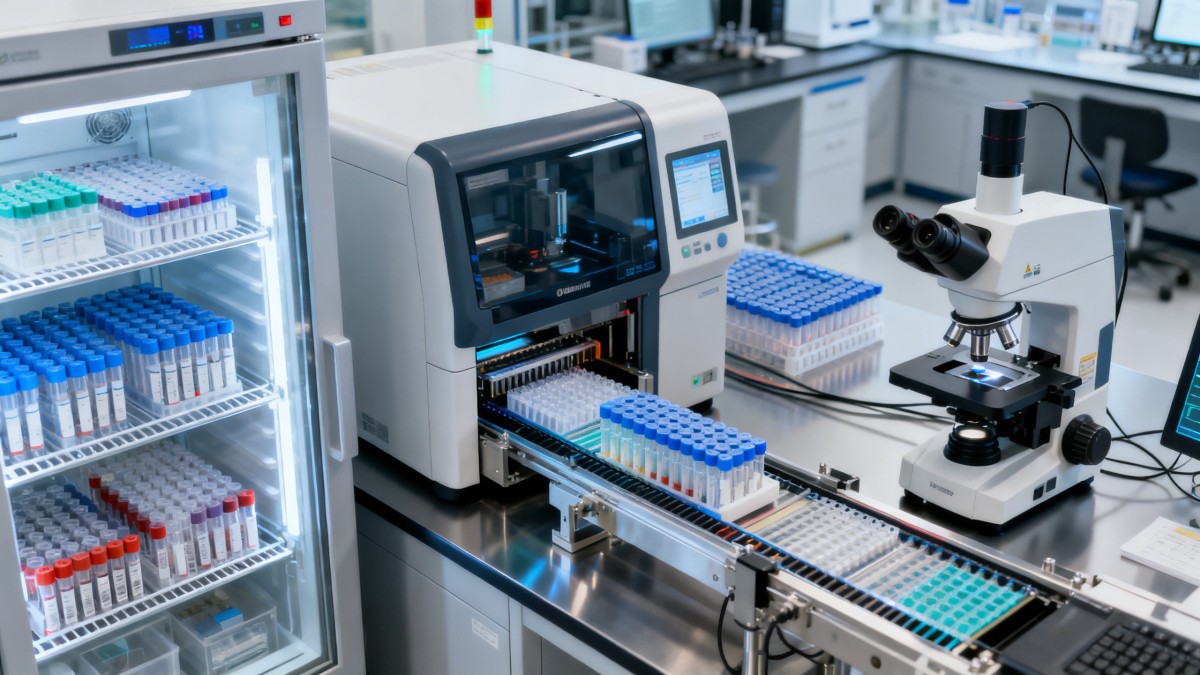
Many life sciences labs focus on visible downtime such as instrument breakdowns, failed assays, or delayed reagent delivery. Those events matter, but they are not the only source of inefficiency. In many facilities, the larger cumulative loss comes from low-visibility routine friction: 2-minute handoffs, 3-step relabeling, 10-minute warm-up delays, duplicate entries into LIMS and spreadsheets, or repeated microscope adjustments between users.
These hidden delays often cross department boundaries. A quality team may wait for environmental logs. A project manager may lose half a day because sample chain-of-custody records are incomplete. An operator may repeat an immunoassay run because antibody storage history was not documented at the point of use. None of these events looks dramatic, yet together they can reduce effective lab capacity by 10% to 25% in busy settings.
In IVD and POCT environments, time loss has an even sharper consequence because the workflow is linked to clinical or near-clinical decision speed. A 15-minute delay in one instrument queue can trigger missed reporting windows, repeated controls, or extra staff intervention. In biopharma R&D, the same pattern delays experiment cycles, extends project timelines by 2 to 5 days per phase, and increases the cost of rework.
Where the leaks usually happen
The most common points of unnoticed time loss are not exotic. They usually appear in sample intake, reagent preparation, calibration checks, environmental stabilization, user changeover, image acquisition presets, and review-and-approve steps. The pattern is especially common when different teams use different naming rules, storage practices, or SOP interpretations.
- Sample accessioning takes 20 to 40 seconds longer per item because labels are reformatted manually.
- Instrument startup requires 15 to 30 minutes because standby protocols are inconsistent across shifts.
- Cell culture media preparation is repeated in smaller batches than needed, creating 2 to 3 extra preparation cycles each week.
- Microscopy users reconfigure illumination, focus mapping, or laser settings instead of loading validated presets.
A useful first step is to measure total touchpoints, not only total run time. If one assay takes 25 minutes on paper but involves 8 manual interactions, the real burden is not the instrument cycle alone. It is the labor exposure, interruption risk, and recovery time when one of those touchpoints fails.
Operational signs that hidden delay is already significant
Labs should investigate hidden time loss when overtime rises without increased output, when repeat tests exceed the expected internal range, or when users regularly build workarounds outside official systems. Those workarounds often indicate that the configured process is slower than the practical process required to meet deadlines.
The Highest-Risk Bottlenecks Across Equipment, IVD, Reagents, and Imaging
Time loss is not distributed evenly across the lab. Some workflow zones create much larger downstream disruption than others. In life sciences settings, the most expensive bottlenecks often sit at the intersection of equipment readiness, reagent stability, result traceability, and data interpretation. These are the points where one small delay can multiply into 3 or 4 additional tasks.
For example, analytical instruments and sterilization systems may appear available, but if maintenance windows are poorly timed, they create queue stacking. Similarly, in immunoassay and molecular diagnostics workflows, a control failure near the end of a run wastes not just the assay time but also sample preparation, operator supervision, and result review time. In imaging workflows, poor file organization can add 10 to 20 minutes per dataset during downstream analysis.
The table below shows common hidden bottlenecks and how they typically affect lab time, accuracy, and operational risk.
The key takeaway is that bottlenecks with the highest time cost are often the ones that also affect quality and compliance. That is why decision-makers should not evaluate delay only by minutes lost. They should also ask how many downstream records, repeat steps, or approval dependencies are created by the delay.
A practical way to rank bottlenecks
A simple triage model uses 4 criteria: frequency, recovery time, quality impact, and traceability risk. If a problem happens more than 3 times per week, takes over 10 minutes to recover, affects result consistency, and requires manual documentation, it deserves immediate process review.
- Map the full workflow from sample intake to result archive.
- Count manual touchpoints and handoffs for each step.
- Measure waiting time separately from active processing time.
- Flag steps that combine technical delay with documentation burden.
This method is useful not only for operators but also for procurement and project leaders. It helps them distinguish between a faster device and a faster workflow, which are not always the same thing.
How Better System Design Reduces Delay Before More Headcount Is Added
When labs face throughput pressure, the first instinct is often to add personnel or extend operating hours. In many cases, that helps only temporarily. If the workflow still contains fragmented interfaces, unbalanced workstation sequencing, and nonstandard setup routines, additional staffing simply spreads the inefficiency across more people.
A stronger strategy is to redesign workflow around readiness, repeatability, and data continuity. In practical terms, that means choosing equipment and software combinations that reduce handoffs, stabilize preparation time, and allow standard presets or method templates to be reused across operators and shifts. Even a 10% reduction in setup variance can improve schedule predictability across a full week.
For laboratory equipment and automation, valuable improvements often come from integrated scheduling, digital maintenance prompts, barcode-linked consumable tracking, and environmental monitoring that feeds directly into the operational record. In precision optics and imaging, user-specific profiles and validated acquisition templates can cut changeover time from 12 minutes to 3 to 5 minutes in multi-user systems.
Design priorities that usually deliver measurable gains
- Reduce duplicate data entry by linking instruments, sample IDs, and result files through one traceable record path.
- Standardize common methods so routine assays or imaging sessions start from locked templates rather than manual reconstruction.
- Use preventive maintenance windows based on runtime and risk category, not only calendar dates such as every 30 or 90 days.
- Align storage layout with workflow order so reagents, antibodies, tips, and controls are reached in 1 sequence rather than 3 separate retrieval paths.
The next table compares common improvement approaches and the types of delay they address most effectively.
The common thread across these actions is that they reduce process friction before increasing labor cost. For technical evaluators and enterprise decision-makers, this usually produces better long-term value than solving bottlenecks only with additional staffing.
Why interoperability matters in purchasing
A system that performs well as a standalone unit may still create hidden delay if it cannot exchange records, method parameters, or maintenance alerts with adjacent workflows. During procurement, asking 6 to 8 interoperability questions can prevent years of manual bridging work after installation.
What Procurement, QA, and Project Leaders Should Evaluate Before Buying or Upgrading
Time efficiency in life sciences labs is shaped long before daily operation begins. It is often decided during specification writing, vendor comparison, FAT/SAT planning, and implementation design. If procurement focuses only on headline performance metrics such as throughput per hour or resolution range, the lab may still inherit slow setup, high maintenance interruption, or weak data continuity.
Buyers should evaluate the full operating model: training load, user-changeover time, preventive service frequency, software usability, consumable dependency, and documentation burden. A platform that requires 3 days of user training and weekly manual calibration may be less productive in practice than one with slightly lower peak speed but stronger repeatability and easier traceability.
This is especially relevant in regulated or compliance-sensitive environments. QA and safety managers need systems that support clean records, stable environmental control, and clear intervention logs. Project managers need predictable implementation timelines, often in a 3-stage format: pre-install planning, onsite qualification, and post-go-live stabilization over 2 to 6 weeks.
A practical procurement checklist
The table below translates time-efficiency concerns into procurement criteria that different stakeholders can use during technical and commercial review.
This type of review is useful for distributors and channel partners as well. Customers increasingly ask not only what a platform can do, but how quickly it can be installed, validated, adopted, and supported. Commercial teams that can answer those questions clearly are better positioned in complex B2B life sciences sales.
Common buying mistake
One frequent mistake is selecting on peak specification alone. In practice, labs benefit more from stable 85% utilization with low rework than from higher nominal speed paired with frequent resets, difficult calibration, or fragmented records.
Implementation, Monitoring, and FAQ for Sustainable Time Savings
Finding hidden time loss is only the first stage. Sustainable improvement requires implementation discipline, measurable checkpoints, and role-based accountability. Most labs benefit from a 30-60-90 day structure: baseline mapping in the first 30 days, intervention rollout in the next 30, and performance verification in the final 30. This creates enough time to separate one-time adjustment noise from real process change.
Performance tracking should stay simple and operational. Good starting metrics include average setup time, repeat-test rate, queue waiting time, documentation completion lag, and maintenance-related interruption count. Even 5 metrics reviewed weekly can reveal whether gains are real or only perceived.
For organizations building broader lab intelligence strategies, this is where a platform such as GBLS adds value as an information bridge. Technical teams need credible workflow insight across laboratory equipment, diagnostics, reagents, compliance, and imaging. Business teams need those same insights translated into sourcing logic, upgrade timing, and implementation risk awareness.
Implementation steps that usually work
- Audit one high-volume workflow first instead of trying to fix the entire lab at once.
- Measure baseline performance for at least 2 weeks using the same definitions every day.
- Prioritize the top 3 delay sources by total weekly impact, not by user complaint volume alone.
- Assign one owner each for process, data, and equipment follow-up.
- Review results after 30 and 90 days to confirm whether the gains are repeatable across shifts.
FAQ
How do labs know whether hidden time loss is serious enough to justify an upgrade?
If a workflow shows repeated manual re-entry, more than 10 minutes of average queue delay per batch, or a repeat-run burden that disrupts weekly scheduling, improvement is justified. The best choice may be a process redesign, a software integration step, or a hardware upgrade depending on the source of friction.
Which areas usually deliver the fastest operational return?
Labs often see the quickest gains in sample accessioning, method standardization, reagent handling, and imaging presets. These changes usually require less capital than full platform replacement and can reduce daily lost time within 2 to 8 weeks.
What should QA and safety managers watch most closely?
They should focus on delays that also weaken traceability: late log completion, undocumented maintenance intervention, unlabeled aliquots, and inconsistent environmental records. These issues consume time and increase audit exposure at the same time.
How long does a typical workflow optimization project take?
For one defined workflow, a practical cycle is often 4 to 12 weeks depending on the number of users, systems, and compliance requirements involved. Multi-site or highly regulated programs usually require phased rollout with formal verification checkpoints.
Life sciences labs do not lose time only through visible failures. They lose it through small, repeated inefficiencies in equipment readiness, IVD handling, reagent workflows, imaging setup, data transfer, and compliance routines. The labs that improve fastest are usually the ones that measure touchpoints, rank bottlenecks by total impact, and buy systems based on workflow fit rather than peak specifications alone.
For researchers, operators, evaluators, procurement teams, distributors, and enterprise leaders, the opportunity is clear: reduce hidden friction before it grows into cost, delay, and quality risk. If you want deeper guidance on laboratory technology trends, workflow optimization priorities, or solution selection across the life sciences value chain, contact us to discuss your application, request a tailored evaluation framework, or explore more precision-focused lab solutions.
Get weekly intelligence in your inbox.
No noise. No sponsored content. Pure intelligence.
